FIG. 01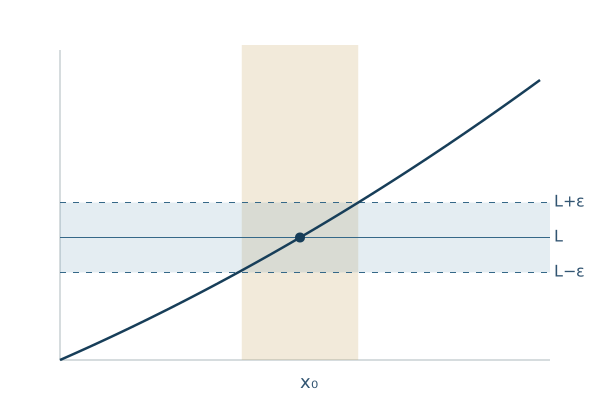
01 / CALCULUS I
ε–δ Limit Explorer
From a horizontal band to a neighborhood of a point. Explore piecewise functions, one-sided limits, and numerical failure witnesses.
Launch explorer ↗MATHEMATICAL SOFTWARE · IN YOUR BROWSER
Three laboratories to explore definitions, build intuition, and ask new questions.
01 / CALCULUS I
From a horizontal band to a neighborhood of a point. Explore piecewise functions, one-sided limits, and numerical failure witnesses.
Launch explorer ↗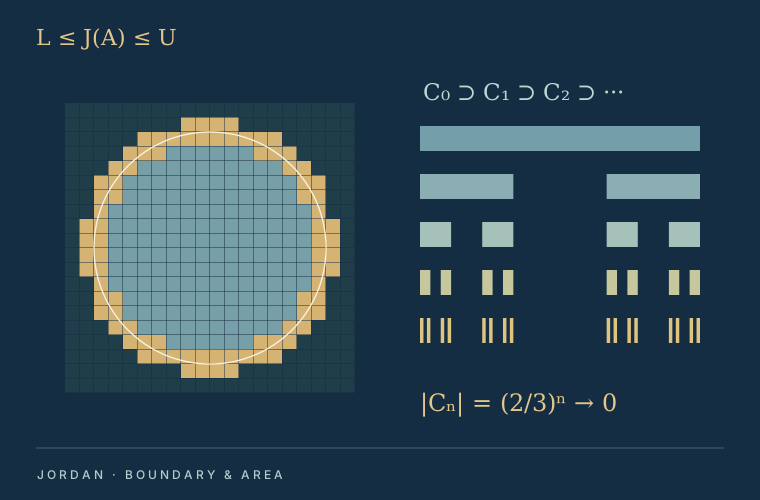
02 / CALCULUS IV
From boundary to area. Build regions, explore dense and Cantor sets, and discover why Dirichlet and Thomae behave differently.
Launch visualizer ↗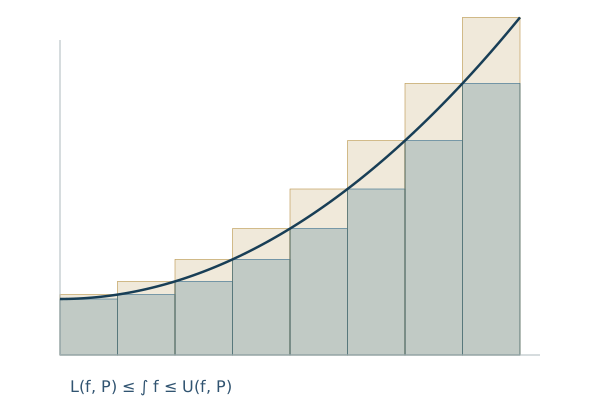
03 / CALCULUS IV
An integral, seen through its partitions. Compare lower and upper sums and follow their behavior under refinement, in two and three dimensions.
Launch laboratory ↗THE DEFINITION
Closeness to \(x_0\) must control closeness to \(L\), for every positive tolerance.
Let \(A\subseteq\mathbb R\), let \(f\colon A\to\mathbb R\), and let \(x_0\in\mathbb R\) be an accumulation point of \(A\). For \(L\in\mathbb R\), we write
\[ \lim_{\substack{x\to x_0\\x\in A}} f(x)=L \]
if for every \(\varepsilon>0\) there exists \(\delta>0\) such that, for every \(x\in A\),
\[ 0<\lvert x-x_0\rvert<\delta\quad\Longrightarrow\quad\lvert f(x)-L\rvert<\varepsilon. \]
We do not require \(x_0\in A\): the value of \(f\) at the center does not enter the definition.
Let \(D\) be the domain of \(f\), restricted to the selected side for a one-sided limit. The point \(x_0\) must be an accumulation point of that domain. Let \(B_\varepsilon\) be the set of points \(x\in D\setminus\{x_0\}\) for which \(\lvert f(x)-L\rvert\geq\varepsilon\).
We use the convention \(\inf\varnothing=+\infty\). If \(0<\delta_*(\varepsilon)<+\infty\), every \(0<\delta\leq\delta_*(\varepsilon)\) satisfies the condition for this \(\varepsilon\). If \(\delta_*=0\), no positive \(\delta\) works; if \(\delta_*=+\infty\), every positive \(\delta\) works.
The program searches for the first obstruction in a finite window, applies a numerical margin, and checks a smaller \(\delta\) by adaptive sampling. It also examines the deviation as points approach the center. Results distinguish estimates, failure witnesses, and inconclusive diagnoses; sampling does not replace a proof.
AN EXAMPLE WITH A PROOF
For any \(\varepsilon>0\), we may choose
If \(0<\lvert x-2\rvert<\delta\), then \(1<x<3\), so \(\lvert x+2\rvert<5\). Factoring \(x^2-4=(x-2)(x+2)\), we obtain
This proves the limit for every \(\varepsilon>0\); we do not need the largest possible \(\delta\).
Explore this example ↗